Bowen Community Technology College
Galah Magazine is highlighting remarkable community work in rural and regional Australia in a series made possible by our partnership.
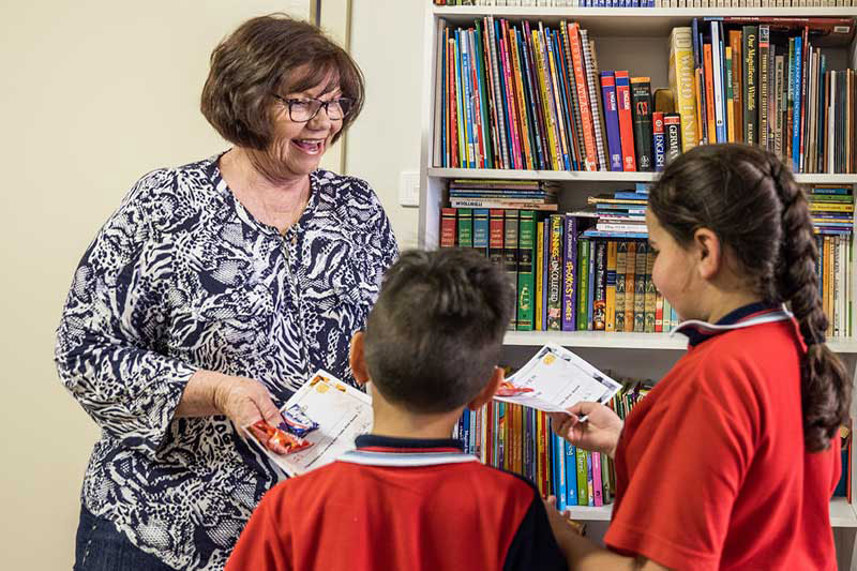
A few years ago, when Paula Townsend was looking for a place to buy in Orange, she called up a real estate agent. ‘Well, you don’t want to buy in East Orange,’ she was told.
Paula didn’t mention that she was born and bred in East Orange. It’s a prejudice she had gotten used to, even though she couldn’t understand it. ‘Orange is very West Orange/East Orange. Although, everybody ends up in East Orange because the cemetery is here.’
Things however are changing, and Paula proudly tells me that East Orange is now referred to as “trendy East Orange” with a “village atmosphere”. If the image of East Orange is indeed changing, it is in part because of the work that Paula herself has been engaged in for the past 14 years at the Bowen Community Technology Centre.
‘In the summer of 2005 and 2006, there were a lot of disturbances around. There were three houses burnt in one street in a week. There were older people that were too scared to go out to even get their mail. Houses were egged or rocked or whatever, there were people too scared to walk around.’
Paula wanted to do something before the problem became bigger.. Deciding that the police wouldn’t or couldn’t help, Paula organised a community meeting. The meeting had to be relocated to a nearby park after 200 people turned up to discuss a problem that was fast getting out of hand.
The problems that needed addressing would not be solved with more policing. Paula explains that ‘It is an area of low socioeconomic levels. There are a lot of people here that have one or two family members in prison at the moment or juvenile detention. We're looking at families that suffer from intergenerational unemployment. Neglect. Many are unable to write. Numeracy and literacy are a big problem with the adults.’
The solution that came out of that public meeting 14 years ago was the Bowen Community Technology Centre. The Centre has become a safe place where children and adults alike can drop in whenever they want to, but if children turn up during school hours they can expect to be met with a hard line of questioning as to why they are not in school.
While the children drop by to use the computers and the printers Paula believes that what the Centre really offers is a place that cares, about the community and about the children. ‘I always say hello to whoever comes in, I don't care who they are. And I’ll ask, how was your day? What did you learn at school? What can you teach me? I'm sort of looked on as the grandmother, the tough grandmother. We have very few rules, but you stick to them. And if you don't stick to them, don’t let the door hit you on the way out.”
If Paula sounds tough it is because she has needed to be. When the centre first opened Paula and other locals from the community would stand guard outside of the little hall where the Centre was housed, protecting it from some members of the community who wanted to tag it in graffiti and others who wanted to knock it down. Then in 2008, on crutches as she recovered from a hip operation, Paula herself was attacked by a young child of no more than 11 years old. ‘He knocked me down. I crawled over and got myself back up and said to him, “have another go”. I had to stand my ground. And they had to learn that I wasn’t scared. But I was scared. Truly scared’.
After the centre was up and running Paula turned her attention to another problem she saw. ‘There used to be only one way in one way out of this area,’ she tells me. People felt closed off, locked in and forgotten. Paula set about campaigning for a pedestrian bridge that would open up access to the neighbourhood, even confronting local politicians who had long promised better access. Paula points out the bridge to me, proud of her role in getting it built. The bridge represents more than access, it represents the recognition of a community, of the needs of that community. ‘It was a forgotten area,’ Paula says. ‘And nobody deserves to be forgotten.’
Today the Bowen Technology Centre houses 14 computers that are free to use. Printing is also free. If you need a resume typed up or a job application filled in, Paula will do that for free for you too. ‘I am not a very good typist, but I get it right.’ Paula has lost track of the number of jobs she has helped people get or how many thousands of children have passed through the Centre, but a few examples stick in her mind.
‘Not long ago, I heard back from a girl called Mary. She looked me up on Facebook, and sent me a message and said, “you might not remember me”.’
But Paula did remember Mary, a young Sudanese girl who used to visit the Centre with her mothers and brothers. Paula would give the children word puzzles to do. Each completed puzzle would be rewarded with a chocolate. Mary had written to tell Paula that, though that she only did the puzzles for the chocolates, those puzzles had given her a love of words, a love that had led her to start studying law.
As Paula and I talk, Terry, a man in his 30s walks in and takes his place at one of the computers. Terry is scrolling through house listings and I interrupt to ask him what he likes about the Centre
‘It's sort of relaxing. You can take your time here. Paula is good for a chat and it’s not too noisy. Paula is very encouraging. She’s a big encouragement for me. I lost my mum recently, so yeah, it’s good to chat.’
I let Terry get back to his house hunting. I have one last question for Paula and I ask her what she has learned over the last 14 years. She doesn’t hesitate in answering. ‘I've learned that everybody is an individual and they need to be treated individually. Everybody likes a little bit of care. Everybody needs rules. Everybody needs a bit of fun. And I get the most fun every day because I have the best job in the world.’
Bowen Community Technology College is a previous recipient of the Westfund Community Grants program. This story is captured by Galah Magazine.