Home at Last
Galah Magazine is highlighting remarkable community work in rural and regional Australia in a series made possible by our partnership.
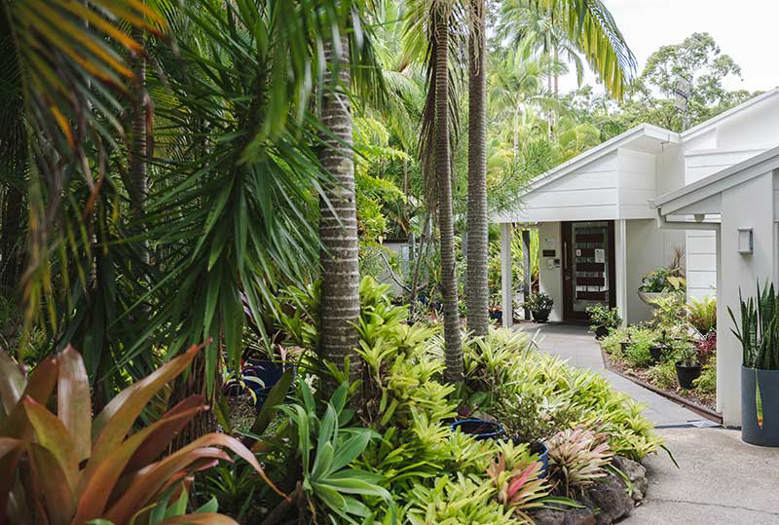
Australians like to consider themselves a pretty resilient bunch. Ready to take things head on and face the facts. But when it comes to death, we tend to shut down, turn our backs on the hard conversations, bury our heads in the sand and hope it won’t happen. Not to us, not to our family.
On Queensland’s Sunshine Coast, a group of volunteers is looking death in the face, staring it down not as an enemy to be feared but as a natural part of life that deserves the same care and attention as all the other aspects of living. In doing so, they’re providing comfort and care to people making their final journey, the journey that one day we all must make.
Katie Rose Cottage Hospice opened its doors in August 2018. Set on three acres of gardens at Doonan, in the Sunshine Coast hinterland, the million-dollar home and property were donated by a local family. Transforming it into a home-away-from-home palliative-care unit was an idea developed by a group of local volunteers led by founding chairperson Carol Raye. Since then, more than 300 guests have passed through Katie Rose Cottage, attracted by the promise of dying with dignity, of ending their days surrounded by love and family and respect and, above all, care.
Remarkably, the service is provided at no cost to guests and their families. Guests need pay only for their own medicine; the unit focuses on symptom management and comfort. While State Government funding accounts for about 20 per cent of income, the rest of the resources needed to keep the cottage doors open are sourced from the local Sunshine Coast community via a chain of cottage-run op shops, fundraising events, grants such as the Westfund Community Grants Program, donations and bequests, often from guests who have passed through the cottage.
The work of the cottage and op shops is sustained by more than 250 volunteers, including fundraisers, gardeners, maintenance teams, carers and administrators, and a small number of specialist paid staff. The whole enterprise feels very much as if it is from the community, for the community.
The cottage operates on a home-away-from-home care model that is widely used in the United Kingdom and New Zealand, but not so common in Australia. Guests and families are accommodated for up to six weeks while Katie Rose staff take care of every need, ensuring that guests and their families make the most of the precious time they have left together. End-of-life care is provided by a clinical team of 18 nurses, 14 assistant nurses and three GPs.
At present, only three guest beds are available. While demand exceeds capacity, this scale ensures that guests and their families receive unprecedented levels of care and attention during their stay. Guests arrive principally on referral from local doctors and Queensland Health. Some guests stay for weeks, some only a few hours. Though most have been Sunshine Coast residents, Katie Rose is open to guests from anywhere in Australia. A recent government grant is funding expansion to five beds.
The work and reputation of Katie Rose Cottage has gained the attention of the Queensland Government, interested in a palliative-care model that is more cost-effective than the public hospital model in wide use and that delivers a higher level of care and compassion for families during their most difficult times.
Having seen the results for themselves, the staff and volunteers at Katie Rose hope their model of end-of-life care can be rolled out in more locations. Because everybody deserves respect and love and care. And because, though dying is difficult, at Katie Rose there is such a thing as a good death.
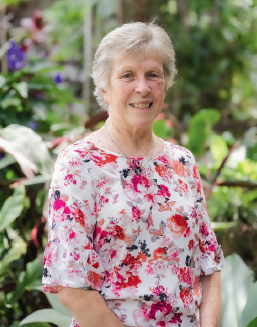
CHRISTINE JOHNSTONE
Assistant in nursing
During a long career in aged care, Christine Johnstone saw a lot of things. One of her nagging doubts was always that palliative care could be done better. “Aged care homes are good at what they do,” she tells me, “but they don’t understand palliative care.”
When Johnstone heard about the work being done at Katie Rose Cottage, she knew she wanted to be involved. She had already retired from nursing, but the thought of being able to help someone in their final days made the decision to return to work an easy one. Such is her love of the place that when she’s not working at the cottage, she’s volunteering at the cottage.
What makes the care at Katie Rose so special? “Compassion,” says Johnstone, without hesitation. “Providing people the opportunity to live pain free. And it is just a lovely environment for those last few days or weeks. It’s a holistic approach. If the guest is able to talk, they can tell us what they would like, what they want us to do, and it’s just very individual.”
The cottage promises to be a home away from home and families are encouraged to stay if that’s what is needed. Beds are made up, stretchers rolled out. “It’s a family home. And we are receiving them as guests in our home,” Johnstone says. “Katie Rose has beautiful, grand grounds with lots of little seats and other alcoves and small rooms where people can go and sit. We encourage the family to use the facilities. They have the run of the kitchen, and they can go anywhere in the house.”
It is a mystery to Johnstone why more people don’t discuss their end-of-life needs. “Everybody talks about having a baby, what has to be done, what hospital you are going to have it in, but nobody ever talks about the end. And that’s important.”
Johnstone suggests end-of-life arrangements should be made long before they’re needed. And while the care here is tailored to individuals, Johnstone believes there are a few things that every guest needs. “Every person deserves the love and the compassion. We don’t judge anybody when they come in, and everybody gets the same love and care from the doctors down to the volunteers. Everybody gives their all because it’s important to; it’s important to me that the person has the best we can give them for their final days.”
As I’m wrapping up our interview, Johnstone interrupts politely. She wrote something earlier in the day and could she read it to me? Of course, I say.
“I feel very humbled and honoured to care and support guests and their families in what is a very private time,” she says. “I hope what I give helps to give them comfort and makes a difference in their final days.”
I have no doubt it does.
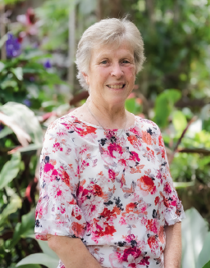
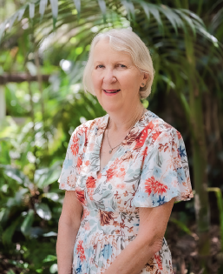
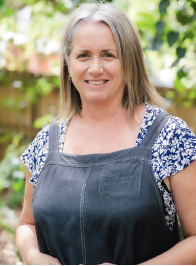
CHERYL BURNS
Hospice support volunteer
Cheryl Burns’s role is to meet and greet guests and families, as well as support the cottage’s personal carers, nurses and doctors. She cooks, makes beverages, cleans—whatever guests, families and staff need.
Burns retired to the Sunshine Coast after a 40-year career at the University of Queensland, and saw volunteering as a way to get involved in a new community. Her only criterion was that it had to be rewarding.
Has she found what she was looking for in a volunteer role?
“I feel it’s so rewarding. And I feel I have benefited from it. It’s really grounded me.” I ask, in what way? “It’s made me not sweat over the small stuff. You’ve just got to appreciate life, your loved ones around you, and your friends.”
In the beginning, though, before she walked into the cottage, Burns wasn’t sure if a role in palliative care would be for her. “I’ll be honest, I had doubts, because it’s palliative >
care. I just said, ‘I’ll see how I feel and if I can cope in that environment’.” Her doubts lasted no longer than her first day at work. “From the time you walk through that front door at Katie Rose, it is so calming, it’s like a breath of fresh air. It’s like sunshine in the house. It’s just such a peaceful environment.”
Burns believes the heroes are the nurses and carers. “They are so beautiful. They’re just beautiful people. The palliative care nurses are so tender. They know just what to say, what to do. It’s lovely to see.”
Even so, Burns admits there are tough times and sad times, and a grief counsellor is on hand to provide support and training to staff, guests and families. “I feel that has helped me immensely,” Burns says. “Understanding the death process, understanding the grief.” And if things get too much? “I’ll go to the beach. I’ll go for a walk. Or I go dancing.” Line dancing, to be precise.
Burns has no regrets about her decision to volunteer her time. “It’s such a lovely environment that Katie Rose offers for end of life for the guest and family. And if I can give my time and volunteer then I feel it’s an honour. It’s an honour to support the guest and the family in their final hours in their life, at this final stage of life.”
KATHY BRUCE
Clinical nurse coordinator
Kathy Bruce describes her role as “a bit of everything” but essentially she handles the clinical side of palliative care: referrals, managing staff and dealing with the families of the guests.
She describes the care offered as “exceptional”, a standard she attributes to the personalised attention afforded to every guest who spends their final days at Katie Rose. “Our patient-to-nurse ratio is one registered nurse and one assistant nurse to three patients.” By comparison with the reported patient-to-nurse ratios in hospitals around Australia, this is an improvement of 100 per cent or more.
It is an important difference. “That allows us time to really get to know the person who we’re caring for. We also get to know their families. That allows us to provide care to the guest and include the family and the patient in the care.”
In two-and-a-half years at the cottage, Bruce is impressed by the esteem in which Katie Rose Cottage is held in the local community.
“It’s a community-orientated place, and it’s got a nice feeling. There are a lot of volunteers who work for us; they give up their time to help us. We have hospice support volunteers: they come in and they cook and they clean, and they answer the door for us. We also have a volunteer maintenance team and a volunteer gardening team.”
This sense of community spirit is palpable and influences the care that guests are given. “The people at Katie Rose are genuine: they aren’t just here to make a dollar. They’re here to help and to be part of something. It’s not a corporate business where you’re working for people who are just trying to generate money. It’s about providing quality care more than anything else.”
While at times the work can be hard, and Bruce mentions the particular sadness that is associated with younger guests who leave behind young families, she’s convinced that exceptional palliative care makes a difference in a person’s final days.
“There is such thing as a good death. Those last few weeks are your time to say goodbye and to get rid of any grudges and to be together and appreciate the people around you. It’s an important time, even though it’s a sad time.”
Though it may sound strange, providing guests and their families with the best death possible seems to bring a unique sense of fulfilment to Bruce and to all the staff at Katie Rose Cottage. “It is a privilege,” she says.
Bruce texts me a few hours after our interview.
“I forgot to add that dogs are allowed to visit, which makes a massive difference to a person. I’ve seen guests’ faces light up when their dog walks in.”
At Katie Rose Cottage, they really do think of everything.
Katie Rose Cottage is a previous recipient of the Westfund Community Grants program. This story is captured by Galah Magazine.